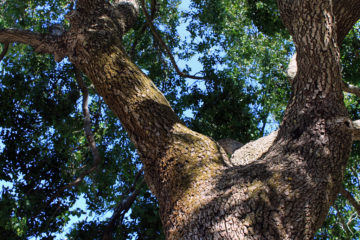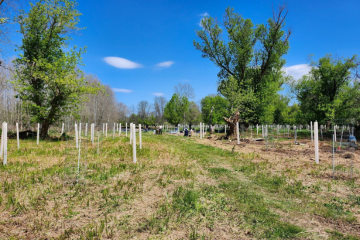
What is likely to be Raritan Headwaters Association’s largest restoration effort to date has been underway since 2022. RHA is actively working toward planting 10,000 trees to restore at least 8 miles of stream buffer throughout the Raritan Watershed. I’m Rose, a summer stewardship intern, working with Robert Lucas, Restoration Coordinator to learn the ins and outs of these plantings and assess their success so far.
Riparian buffer zones are essentially the floodplain of a body of water. It’s the land directly adjacent to a waterbody that contains a variety of vegetation, including trees, shrubs, and herbaceous perennials. The types of plants we plant in these buffer zones are extremely important! Based on the space we have to work with, we choose plant species based on what’s called their Wetland Indicator Status, which was established as part of the National Wetland Plant List (NWPL) by the U.S. Army Corps of Engineers in 2006; it essentially categorizes plants based on whether they do or don’t occur in wetlands. A wetland is a wetland if it meets 3 basic criteria: has hydrophytic vegetation, contains hydric soils, and shows wetland hydrology. The NWPL informs the hydrophytic vegetation criterion when wetlands are delineated, but also serves as a helpful tool for RHA when planning our planting sites.
So let’s say we are planning a planting that will have a 250 ft buffer zone. Since this buffer zone is a generally larger riparian buffer zone, we may choose a wider variety of species to plant, given that some of the buffer zone will be more of a wetland closer to the waterbody, and some of it may be more upland. The table below will give you a better idea of what this means using species we use in our plantings:
| Scientific Name | Common Name | Plant Type | Wetland Indicator Status | Meaning |
| Acer sacharinium | Silver Maple | Tree | Facultative Wetland (FACW) | Usually occur in wetlands, but may occur in non-wetlands |
| Nyssa sylvatica | Black Gum | Tree | Facultative (FAC) | Occur in wetlands and non-wetlands |
| Carya ovata | Sagbark Hickory | Tree | Facultative Upland (FACU) | Usually occur in non-wetlands, but may occur in wetlands |
| Alnus serrulata | Smooth Alder | Shrub | Obligate (OBL) | Almost always occur in wetlands |
The last status on this table would be Upland (UPL), however, we don’t use upland species in our planting sites since the buffer zones we restore typically don’t exceed 300 ft, as per New Jersey state regulations, so most times, these species we plant will be in hydric soils. Also, keep in mind that the species listed on this table are only a fraction of the species we plant at our planting sites; so far, we have planted 40 species of trees and shrubs throughout the Raritan watershed.
A key function of my internship this summer was assessing the survival of these species at our current planting sites that are older than 1 year. As a lifelong Pennsylvania native, I can safely say that I now know more about the waterbodies in New Jersey than I do in Pennsylvania (don’t tell anyone, okay?). You can find our planting sites along the North and South Branches of the Raritan, Peapack, Herzog, Chambers, and Walnut Brook, the Black River, and many more to come in future plantings.
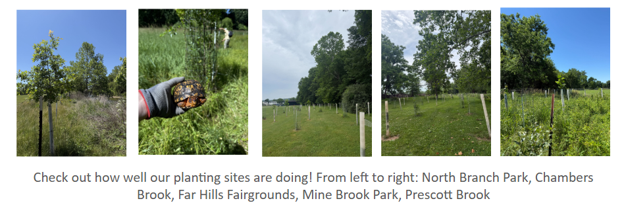
On our visits to these sites, survivorship is determined by counting every single living tree left. We usually determine survival by the presence of leaves, or if it’s not obvious, by scratching the bark to see if there’s anything green remaining underneath. In addition to survivorship, we also take care of any site maintenance that is necessary, including invasive species removal, fixing the cages and tubes protecting the plants, and removing all dead plants and their protection from the site. The planting sites we maintain vary in size, with some only having about 100 plants on a private property, and others having 1,000 at a large public park. Regardless of a planting’s size, restoring our riparian buffer zones is relevant and meaningful work! For 2026, among all of our planting sites older than 1 year old, we recorded a 77% survival rate, and from the photos below, you can see these sites are thriving.
Now, here’s the “why” behind the work we do in case you’re curious. Restoring riparian buffer zones has a wide range of benefits, both for the natural world and for us humans, including:
- Filter and maintain water quality for over 1 million people in the Raritan Watershed who consume its water
- Improve biodiversity in and out of waterbodies by providing places for wildlife to live and reproduce, while also increasing connectivity between habitats.
- Mitigate flooding impacts from storms that have become increasingly severe due to increased climate impacts
- Assists groundwater recharge, maintains flow during dry season, and serves as a carbon sink
- Protection from deer herbivory and reestablishment of invasives
- Increased soil stability to prevent erosion over time.
Work like this never stops, which is what I find most joyous about being employed by Mother Nature – there is always more work to do and a difference to make. Make sure to check out the rest of RHA’s website to learn more about the work we do.
If you are interested in volunteering or assisting with RHA’s riparian buffer zone project, please contact Robert Lucas, RHA’s Restoration Coordinator rlucas@raritanheadwaters.org for more information.
Happy planting!
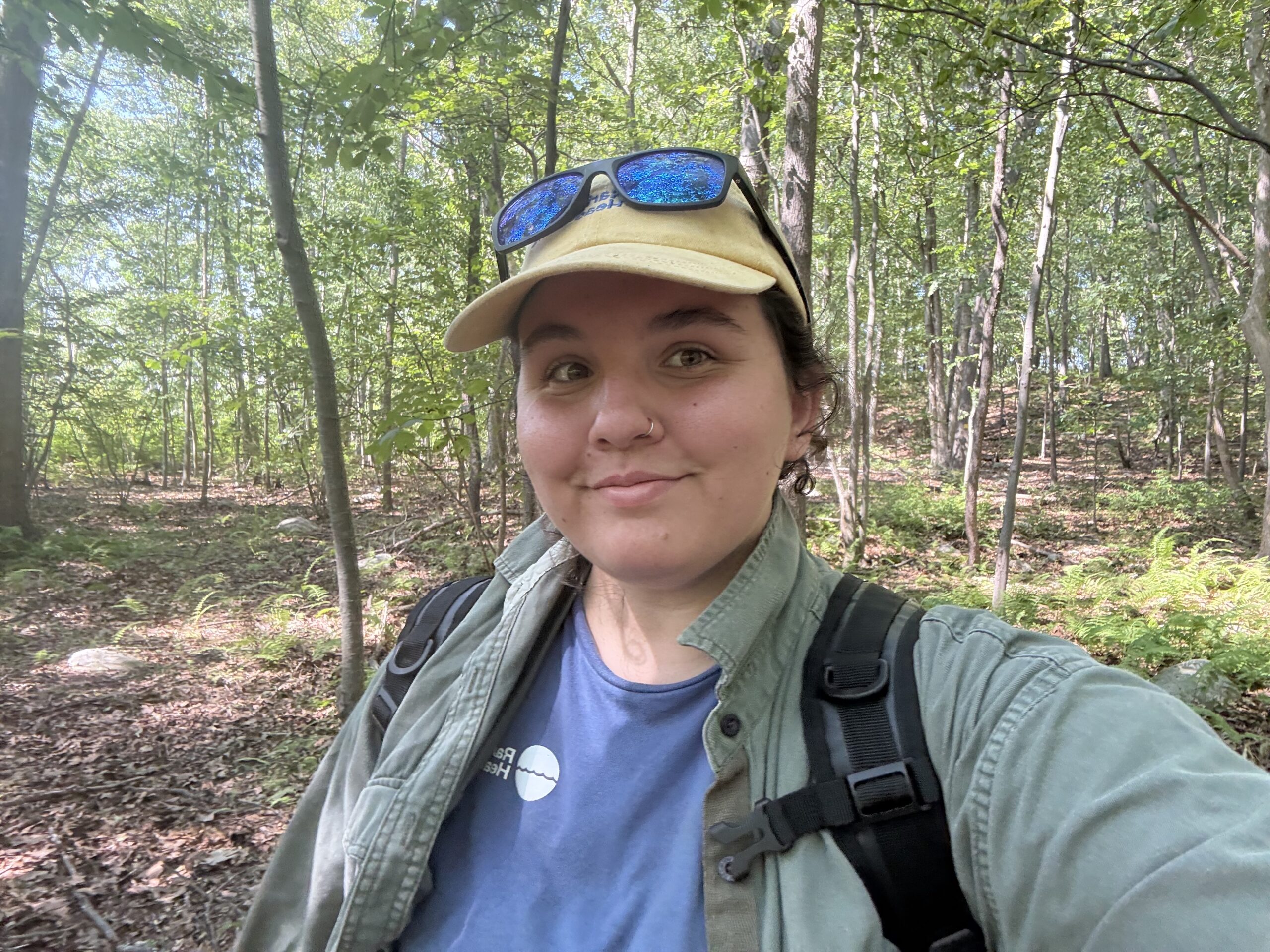 Meet Rose Falletta
Rose served as an Environmental Stewardship Intern for RHA this summer where she worked on various projects including planting site survival monitoring, water quality monitoring, and trail maintenance. She now is an Environmental Education Fellow at Riverbend Environmental Education Center in Gladwyne, PA as well as an Animal Care Intern at the Lehigh Valley Zoo.